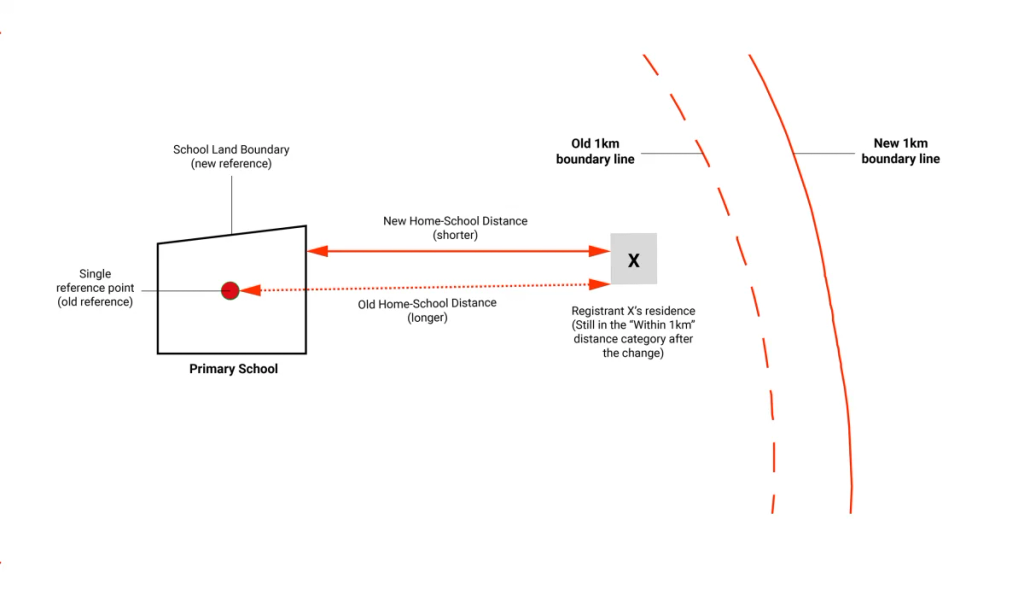
Phase 2C Home-School Distance Rules: What Singapore Home Buyers Should Know
For many Singapore families, choosing a home is also a decision about primary-school access. A property’s distance from a popular school can affect a child’s priority category when a registration phase is oversubscribed. But being “within 1km” is not an automatic admission ticket, and a new address can bring new competition as well as new opportunity.
This guide explains the home-school distance framework, the change from measuring distance from a school’s centre to its School Land Boundary (SLB), and what home buyers should examine before paying a premium for a home near a sought-after primary school.

How home-school distance affects Phase 2C
When a Primary 1 registration phase has more applicants than vacancies, MOE conducts balloting. Home-school distance is one of the priority categories used in the process. Broadly, applicants may fall within the less-than-1km band, the 1km-to-2km band, or beyond 2km. Citizenship and the registration phase also matter, so distance should be understood as one part of a wider process rather than a guarantee.
Phase 2C is especially relevant to home buyers because it is open to children with no prior connection to the school. Popular schools may therefore attract families from a wide catchment. A household considering a resale flat, condominium or landed property should check the child’s likely eligibility using the exact address, block and postal code—not simply the project name or a radius drawn on a commercial map.
The Singapore Land Authority’s OneMap School Query Service is a useful starting point. It helps families check the applicable school-distance category for a specific address. MOE’s registration guidance remains the authority for current rules, deadlines and documentation.
What changed when the measurement moved to the School Land Boundary?
From the 2022 Primary 1 Registration Exercise, distance was generally calculated from the nearest point of the school’s land boundary rather than from the school’s centre. Geometrically, that can extend the practical reach of a 1km zone in several directions. Homes that were just outside the former circle may fall within the newer boundary-based band.
That sounds like good news for owners in the expanded ring. However, the same change can place many more households into competition for the same vacancies. A family moving into a newly eligible development may gain proximity priority, while existing families who were already near the school may face a larger applicant pool.
Property type matters too. An expanded ring can include large HDB neighbourhoods, family-sized condominium projects and landed estates. The number of units, unit mix, completion dates and likely resident profile can tell you more about future demand than a simple “within 1km” label.
Nan Hua Primary in Clementi: why the surrounding pipeline matters
Nan Hua Primary provides a useful example of why buyers should study the whole neighbourhood. The Clementi area includes established HDB housing as well as sizeable condominium projects. Developments such as Whistler Grand and Parc Clematis add a substantial number of homes close to the school, while projects such as Parc Riviera and Monterey Park sit within the broader boundary discussion.
Not every household has a child entering Primary 1, and not every family will choose Nan Hua. Nevertheless, a large increase in family-sized homes can raise the potential applicant pool. Some developments may also straddle different distance bands, meaning one block or postal code can have a different category from another within the same project.
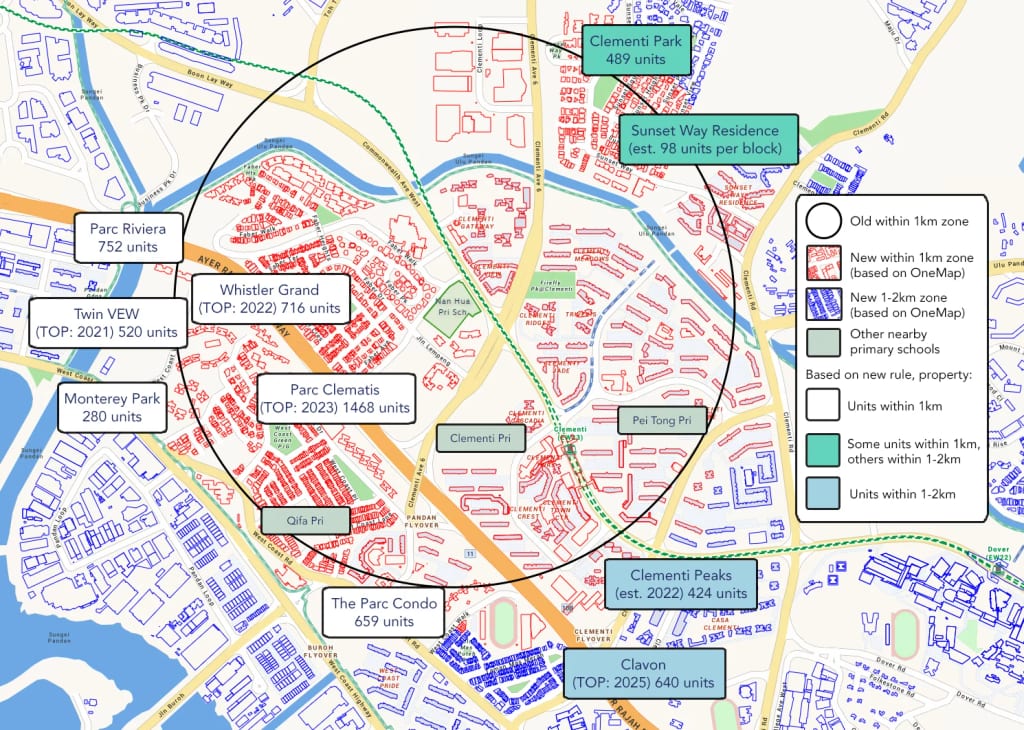
For a buyer, the practical lesson is to verify the exact unit address and to compare Nan Hua with nearby alternatives such as Qifa, Clementi and Pei Tong Primary. A school’s popularity can also change, and the registration outcome in one year should not be treated as a permanent forecast.
Nanyang Primary in Bukit Timah: a smaller but valuable catchment analysis
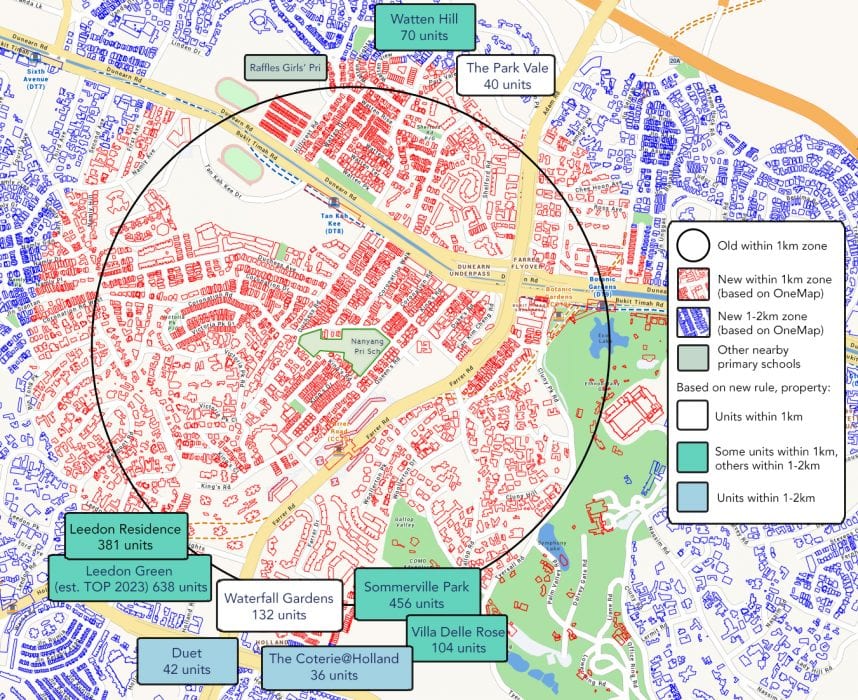
Nanyang Primary sits in a neighbourhood with a mix of landed housing and private developments. Some properties around the southern arc may fall between the new 1km and 2km zones, while others are closer to the school. Nearby schools and the availability of alternative co-educational options can influence which families ultimately apply.
This is an important reminder that a home should not be evaluated solely by its relationship with one school. Consider the walking environment, transport, daily convenience, tenure, layout and resale liquidity as well. A premium paid for school proximity is easier to justify when the property works for the family even if the registration outcome is uncertain.
Tao Nan Primary in Marine Parade: many schools, many choices
Around Tao Nan Primary, families may also consider Tanjong Katong Primary, CHIJ (Katong), Haig Girls’ and Ngee Ann Primary. This broader school cluster makes the East Coast a good case study in how proximity does not necessarily translate into one predictable queue.
The expanded zone includes parts of larger developments such as Silversea, The Seaview, Amber 45 and The Shore Residences, alongside boutique condominiums, landed homes and shophouses. Some blocks can fall within different distance bands, so buyers should avoid relying on a development-wide marketing claim.
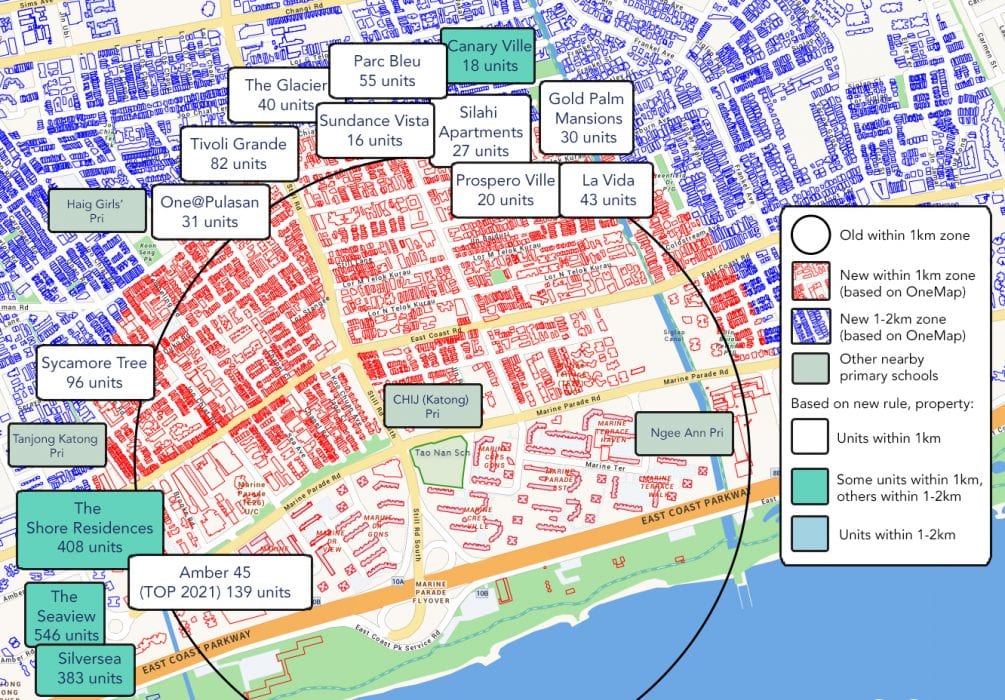
A family choosing a home here should map several realistic school choices and assess each school’s historical demand, vacancies and registration phase. Flexibility can be more valuable than paying the highest premium for one address.
St Hilda’s Primary in Tampines: a high-density demand story
Tampines illustrates how new housing supply can affect a popular school’s competition. The area includes substantial HDB BTO additions and large condominium developments. Treasure at Tampines, for example, has blocks that may fall into different distance bands depending on postal code, while other projects along Tampines Street 86 contribute additional household capacity.
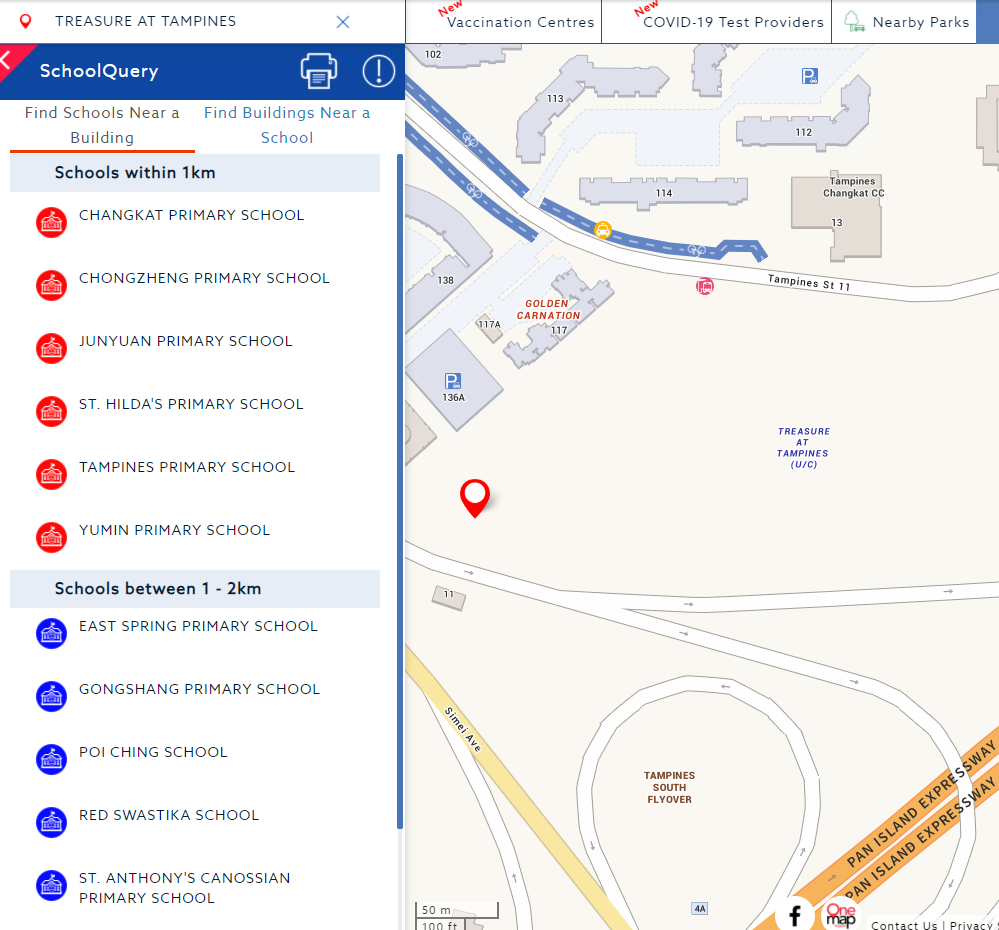
For buyers, the right question is not simply “Is this near St Hilda’s?” It is “How many family-sized homes share this catchment, when will they be occupied, and what other schools are realistic alternatives?” A project with many units can offer amenities and liquidity, but it can also mean a larger pool of potential applicants.
CHIJ St Nicholas Girls’ and Catholic High Primary
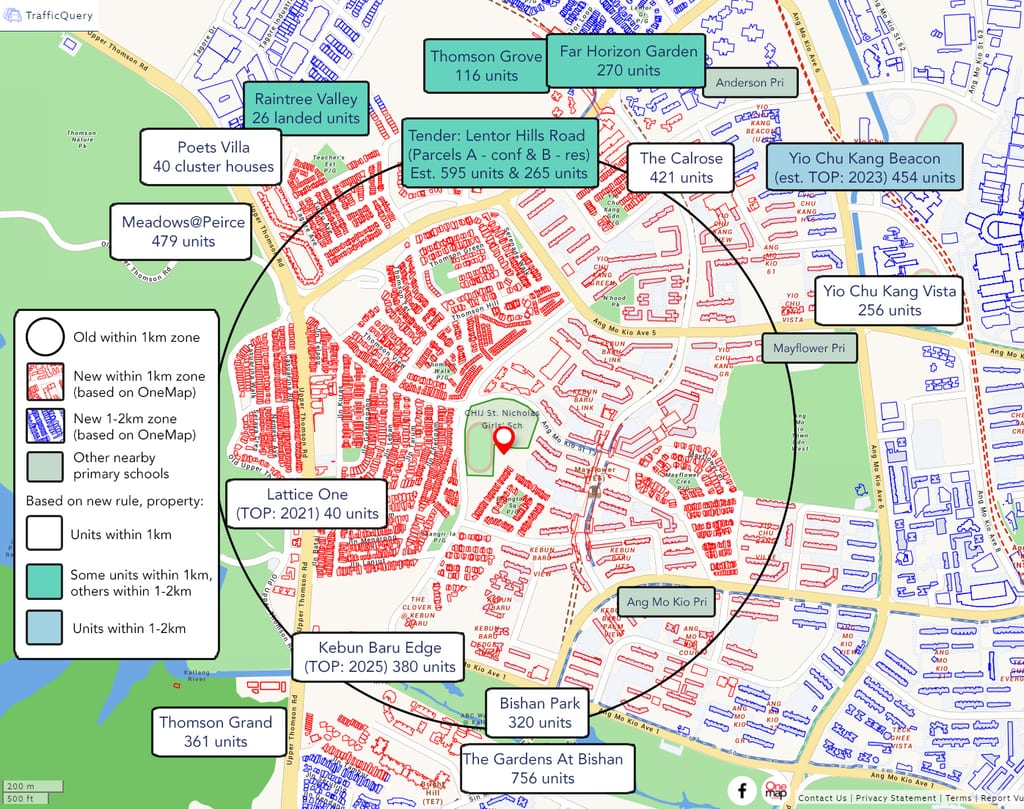
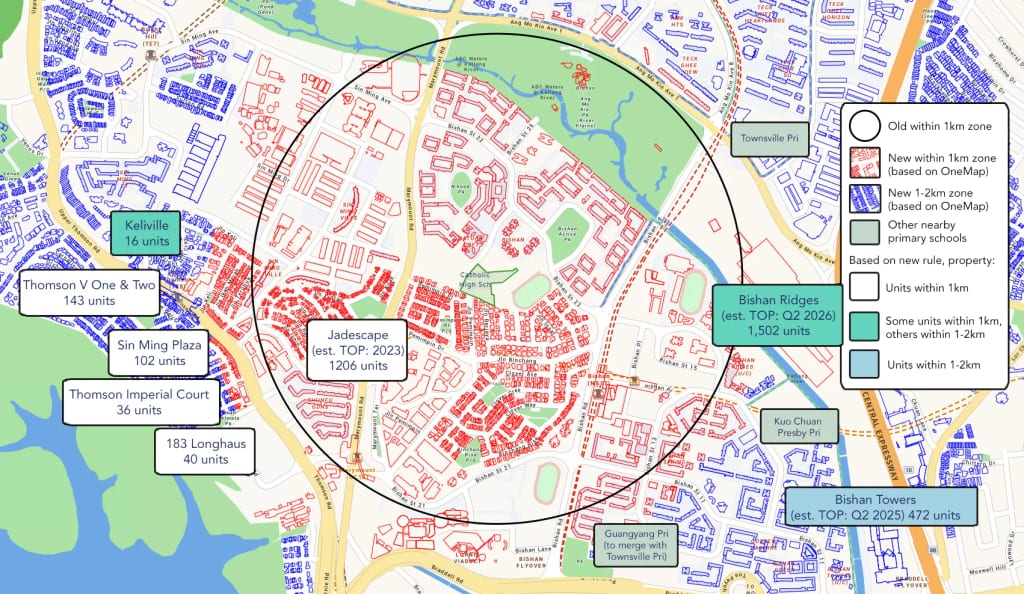
All-girls CHIJ St Nicholas Girls’ Primary in Ang Mo Kio and Catholic High Primary in Bishan show why household composition and neighbourhood change matter. Condominiums, HDB estates and landed areas can all contribute to demand, while nearby co-educational schools provide alternatives for families with sons or for those who prefer a different setting.
Around St Nicholas, projects and HDB developments near the boundary may add families over time. Around Catholic High, established estates sit alongside newer developments, and school relocation or redevelopment plans can alter the local catchment. Buyers should therefore check current MOE information rather than relying on an old property brochure or historical map.
A practical checklist for home buyers
- Check the exact address. Use OneMap School Query for the block, unit or postal code wherever possible.
- Confirm the current rule. MOE guidance and the registration exercise information should take precedence over older articles.
- Study the whole catchment. Count nearby HDB blocks, condominiums, BTO projects and landed homes—not just the property you like.
- Review unit mix and timing. Three-, four- and five-room homes may produce a different family profile from a project dominated by small units. Newly completed developments may also create a delayed wave of applicants.
- Keep alternatives open. Compare nearby schools and consider whether the home remains suitable if the preferred school is oversubscribed.
- Do not overpay for certainty that does not exist. Distance can improve a priority category, but balloting, citizenship, vacancies and annual demand still matter.
The bigger property implication
School proximity can influence buyer demand and resale narratives, but it should be treated as one attribute of a home—not the entire investment thesis. The best decision combines verified school-distance information with fundamentals such as tenure, remaining lease, condition, transport, amenities, maintenance costs and comparable transactions.
The boundary-based method makes accurate address-level research more important than ever. For Jennifer Lim’s clients, the most useful approach is to compare the school map, the property pipeline and the family’s own priorities before committing. A home near a primary school may be a meaningful lifestyle choice, but a successful purchase begins with understanding both the opportunity and the competition.
Rules, school boundaries, vacancies and registration procedures may change. Always refer to the latest MOE and SLA information before making a purchase or registration decision.
Disclaimer
This information is provided solely on a goodwill basis, and does not relieve parties of their responsibility to verify the information from the relevant sources and/or seek appropriate advice from relevant professionals, such as valuers, financial advisors, bankers and lawyers. For avoidance of doubt, PropNex Realty Pte Ltd, and its salesperson, accepts no responsibility for the accuracy, reliability, and/or completeness of the information provided. Copyright in this publication is owned by Sebastian Teo, and this publication may not be reproduce or transmitted in any form, or by any means in whole, or in part, without prior written approval.